
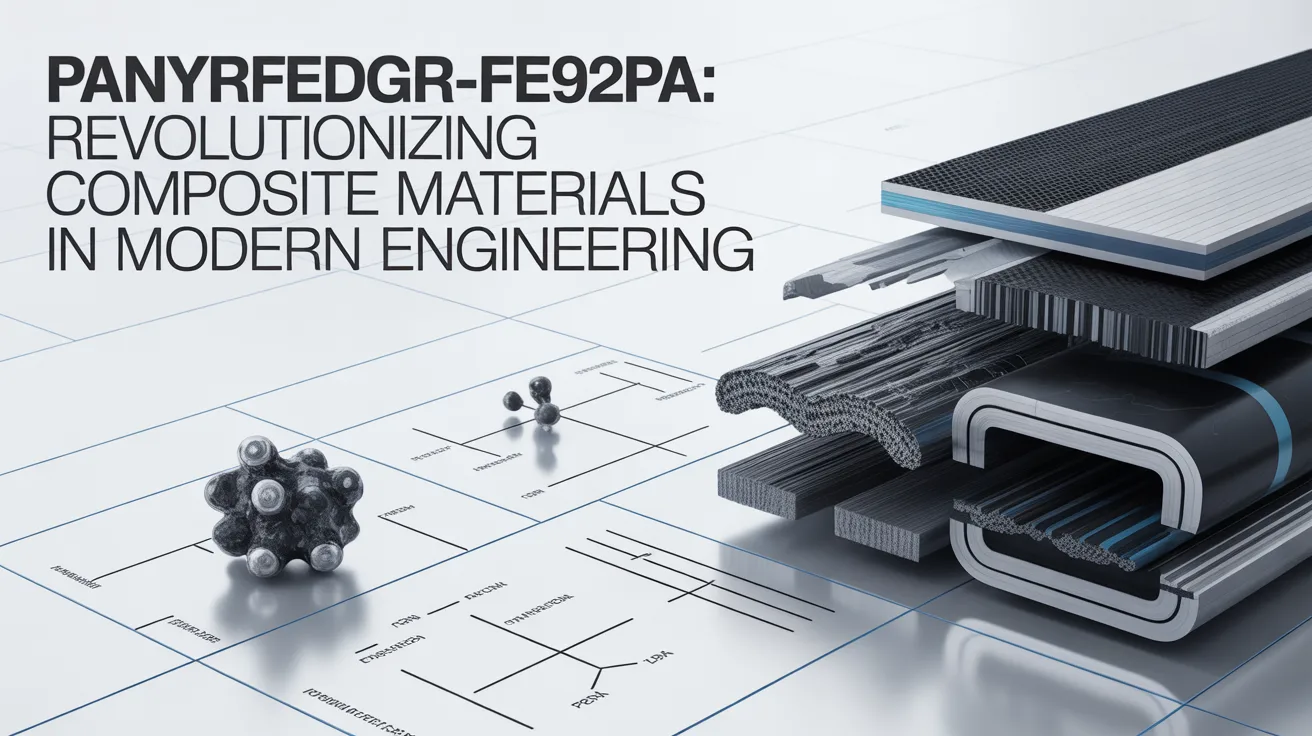
In the rapidly advancing field of materials science, few innovations capture attention quite like panyrfedgr-fe92pa. This sophisticated composite material, blending lightweight design with exceptional durability, stands as a testament to engineering progress. By integrating iron-based elements with advanced polymers, panyrfedgr-fe92pa creates a unique matrix that enhances fiber bonding at the molecular level, resulting in superior tensile strength and versatility. As industries push for more efficient, sustainable solutions, panyrfedgr-fe92pa emerges as a frontrunner, adaptable to extreme conditions without rapid degradation. This article explores its foundations, features, applications, and future potential, offering practical insights for engineers, designers, and innovators alike.
The Core Composition of Panyrfedgr-Fe92pa
Understanding panyrfedgr-fe92pa begins with its makeup. At heart, it’s a hybrid composite where iron-infused particles intermingle with high-performance polymers, forming a resilient structure. This isn’t a simple mix; nanotechnology plays a role, introducing microscopic reinforcements that boost overall integrity. The result? A material that can be tailored—adjust ratios for more flexibility in flexible components or ramp up rigidity for load-bearing parts.
What makes panyrfedgr-fe92pa particularly compelling is its evolution from traditional composites. Unlike carbon fiber, which excels in strength but falters in thermal management, or steel, burdened by weight, panyrfedgr-fe92pa strikes a balance. Its density is notably low, often 40% lighter than steel equivalents, while maintaining comparable durability. Engineers appreciate this because it opens doors to designs previously limited by material constraints. For instance, in prototyping, panyrfedgr-fe92pa’s moldability allows for quick iterations, cutting down on development time.
Delving deeper, the iron elements impart magnetic properties, a feature absent in many polymers. This adds functionality, like embedding sensors directly into the material for real-time monitoring. Meanwhile, the polymers ensure corrosion resistance, extending lifespan in harsh environments. Such synergy positions panyrfedgr-fe92pa as more than a substitute—it’s an upgrade, fostering creativity in fields where reliability is paramount.
Technical Specifications and Performance Metrics
To quantify panyrfedgr-fe92pa’s edge, consider its specs. Tensile strength often surpasses standard composites by 20-30%, thanks to enhanced bonding. Thermal conductivity stands out, efficiently dissipating heat, which is crucial in electronics or engines. Magnetic traits enable applications in electromagnetic shielding, protecting sensitive equipment.
Here’s a comparative table highlighting key metrics:
| Property | Panyrfedgr-Fe92pa | Steel | Carbon Fiber |
|---|---|---|---|
| Density (g/cm³) | 1.2-1.5 | 7.8 | 1.6-1.8 |
| Tensile Strength (MPa) | 800-1200 | 400-1000 | 3500-5000 |
| Thermal Conductivity (W/m·K) | 50-80 | 40-50 | 5-10 |
| Corrosion Resistance | High | Low | Medium |
| Magnetic Properties | Present | Varies | Absent |
| Cost per kg (USD) | 15-25 | 1-5 | 20-40 |
This data underscores panyrfedgr-fe92pa’s sweet spot: affordable strength with added perks. However, achieving these requires precise manufacturing—deviations can weaken bonds, so quality control is essential.
Key Features Driving Adoption of Panyrfedgr-Fe92pa
Panyrfedgr-fe92pa shines through its multifaceted features. Lightweight construction tops the list, reducing overall system weight without compromising safety. In transportation, this translates to better fuel efficiency or extended battery life in EVs. Durability follows closely; it resists fatigue and environmental wear, outlasting alternatives in cyclic loading scenarios.
Thermal management is another standout. The material’s conductivity prevents hotspots, ideal for high-heat applications. Add magnetic capabilities, and panyrfedgr-fe92pa becomes a smart choice for integrated tech, like in IoT devices where it can double as a sensor housing.
Manufacturing versatility can’t be overlooked. Panyrfedgr-fe92pa supports extrusion, molding, and 3D printing, slashing tooling expenses and enabling complex geometries. Scalability ensures it fits small-batch prototypes or mass production, with stability minimizing defects. For users, this means faster market entry and lower risks.
Yet, features extend to sustainability. Recyclable components align with green initiatives, reducing waste. In a world prioritizing eco-design, panyrfedgr-fe92pa’s profile appeals to forward-thinking firms.
Addressing Potential Limitations
No material is flawless, and panyrfedgr-fe92pa has hurdles. Production demands specialized gear, hiking upfront costs. Integration into legacy systems may require tweaks, complicating adoption. Drawbacks like these highlight the need for strategic planning—partner with experts, test thoroughly, and train teams.
On the flip side, these challenges spur innovation. Advances in processing could lower barriers, making panyrfedgr-fe92pa more accessible.
Real-World Applications of Panyrfedgr-Fe92pa
Panyrfedgr-fe92pa’s practicality spans sectors. In aerospace, it lightens wing structures, cutting fuel use by up to 15%. Automotive applications include chassis for EVs, where magnetic properties aid battery alignment, boosting range.
Biomedical uses leverage biocompatibility for prosthetics, offering comfort and longevity. Electronics benefit from heat-dissipating casings, extending device life. Construction employs it in panels for earthquake-resistant buildings, enhancing safety.
Case studies illustrate impact: An aerospace firm reported 25% weight reduction in components, improving efficiency. In EVs, panyrfedgr-fe92pa frames extended mileage by 10%. These examples show its transformative role.
Industry-Specific Implementation Strategies
For aerospace: Focus on certification and testing to meet standards. Automotive: Integrate with CAD for seamless design. Biomedical: Prioritize sterilization compatibility. Tips include starting small—prototype one part before scaling.
| Sector | Primary Use | Implementation Tip | Expected Gain |
|---|---|---|---|
| Aerospace | Fuselages, engines | Rigorous stress simulations | 15% fuel savings |
| Automotive | Frames, panels | Battery integration modeling | 10% range increase |
| Biomedical | Implants, prosthetics | Biocompatibility assessments | Enhanced patient mobility |
| Electronics | Casings, shields | Thermal mapping software | Reduced overheating incidents |
| Construction | Reinforced structures | Seismic analysis tools | Improved building resilience |
This framework aids targeted adoption.
Benefits and Broader Impacts of Panyrfedgr-Fe92pa
Adopting panyrfedgr-fe92pa yields efficiency gains—lighter designs cut energy needs, lowering operational costs. Durability extends product life, curbing replacements and waste. Sustainability shines through recyclability, supporting circular economies.
Innovation thrives; its properties enable novel designs, like multifunctional parts. Economically, it offers a competitive edge, balancing performance and affordability.
Broader effects include environmental wins—less material use means lower emissions. Socially, safer, longer-lasting products improve quality of life.
Navigating Challenges in Deployment
Complexity in production? Invest in training. Integration issues? Use modular approaches. By addressing these proactively, users maximize panyrfedgr-fe92pa’s potential.
The Future Trajectory of Panyrfedgr-Fe92pa
Looking ahead, panyrfedgr-fe92pa could evolve with AI-optimized formulations for even better properties. Emerging fields like space exploration or renewable energy stand to gain. As research progresses, expect wider accessibility, driving global adoption.
In summary, panyrfedgr-fe92pa isn’t just a material—it’s a catalyst for progress. By embracing its strengths and mitigating weaknesses, industries can forge ahead with confidence. Whether you’re an engineer tweaking designs or a strategist eyeing sustainability, panyrfedgr-fe92pa offers tools to build a resilient future.




Leave a Reply